Last Updated on September 17, 2026 by Nasir Hanif
In U.S. criminal law, reckless endangerment generally refers to dangerous conduct that creates a serious risk of injury or death to another person. Depending on the state and the circumstances, a prosecutor may be able to bring a charge even when nobody is physically hurt. The exact definition, offense level, and possible punishment vary because states use different statutes and sometimes different names for similar conduct.
| Key question | General U.S. answer |
|---|---|
| What conduct can qualify? | Conduct that creates a serious, substantial, grave, or imminent risk, depending on state law |
| Must someone be injured? | Often no; creating the prohibited level of risk may be enough |
| Is it always a misdemeanor? | No; some circumstances can support felony charges |
| Does intent to injure have to be proven? | Usually not for a recklessness-based offense |
| Do all states use the same definition? | No; terminology, elements, and penalties differ |
| Can weapons affect the charge? | Yes in some states, including Tennessee |
| Is there one general federal civilian offense? | No comparable nationwide civilian rule applies to every case |
Reckless conduct can become a criminal offense when a person consciously disregards a serious and unjustifiable danger to someone else. In many jurisdictions, prosecutors do not need to prove an actual injury. Instead, they must establish the required mental state, the dangerous conduct, and the degree of risk required by the applicable law.
Key Takeaways
- State law usually determines how dangerous conduct is defined, charged, and punished.
- Creating a serious risk can be enough even if the feared injury never occurs.
- Driving, firearms, fire, dangerous objects, and other hazardous behavior can lead to charges when the legal standard is met.
- The difference between a misdemeanor and a felony may depend on the risk, the weapon involved, surrounding facts, or the degree of indifference shown.
- A charge is not a conviction, and prosecutors must still prove every required element beyond a reasonable doubt.
What Is Reckless Endangerment Under U.S. Law?
The basic idea is that criminal law can punish dangerously irresponsible conduct before it results in serious harm. Merriam-Webster’s legal definition describes the offense as recklessly engaging in conduct that creates a substantial risk of serious physical injury or death. State statutes use similar concepts, but their wording and offense levels are not uniform.
For ordinary civilian cases, the law of the state where the alleged conduct occurred usually serves as the starting point. The Washington State Legislature’s RCW 9A.36.050 defines reckless endangerment as conduct creating a substantial risk of death or serious physical injury. Pennsylvania’s recklessly endangering another person statute refers instead to conduct placing or potentially placing another person in danger of death or serious bodily injury. New York separates lower- and higher-degree offenses based on the seriousness of the risk and surrounding circumstances.
Federal law also uses the concept in narrower settings rather than as one universal civilian offense. Article 114 of the Uniform Code of Military Justice, codified at 10 U.S.C. section 914, applies to people subject to military law and covers wrongful, reckless, or wanton conduct likely to produce death or grievous bodily harm. The federal sentencing guidelines also provide a two-level increase when a defendant recklessly creates a substantial risk of death or serious bodily injury while fleeing law enforcement.
For more general legal explainers and court-related topics, readers can browse NewsPab’s Law section.
What Prosecutors Generally Have to Prove
The exact elements come from the law of the state bringing the case. Still, many statutes center on a few recurring questions about what the accused did, what risk was created, and the person’s state of mind. A prosecutor normally cannot obtain a conviction merely by showing that conduct looked careless after the fact.
Common issues include:
- Whether the defendant engaged in the alleged conduct.
- Whether the conduct was legally reckless rather than merely careless.
- Whether another person was exposed to the level of danger required by the statute.
- Whether the risk involved serious physical injury, serious bodily injury, or death.
- Whether aggravating facts raise the offense to a more serious grade.
Recklessness generally involves more than an ordinary mistake. The federal sentencing guidelines describe it as awareness of a risk that is serious enough that disregarding it represents a gross departure from reasonable care. State definitions can differ, so the precise mental-state instruction used in a criminal trial matters.
Common Examples of Conduct That May Lead to a Charge

No single activity automatically proves a criminal offense because context matters. The same act may be lawful in one setting and dangerously reckless in another, depending on who was nearby, what precautions were taken, and how severe the risk became. Courts and prosecutors therefore examine the full circumstances rather than relying only on the type of activity involved.
Examples that can raise legal concerns include:
- Firing a gun where people, homes, vehicles, or occupied areas may be endangered.
- Driving toward a pedestrian or operating a vehicle in an exceptionally dangerous manner.
- Throwing a heavy object from a height where people are below.
- Starting or mishandling a fire under conditions that expose others to serious danger.
- Handling hazardous equipment or materials while consciously disregarding a major safety risk.
- Creating a dangerous situation involving children or other vulnerable people.
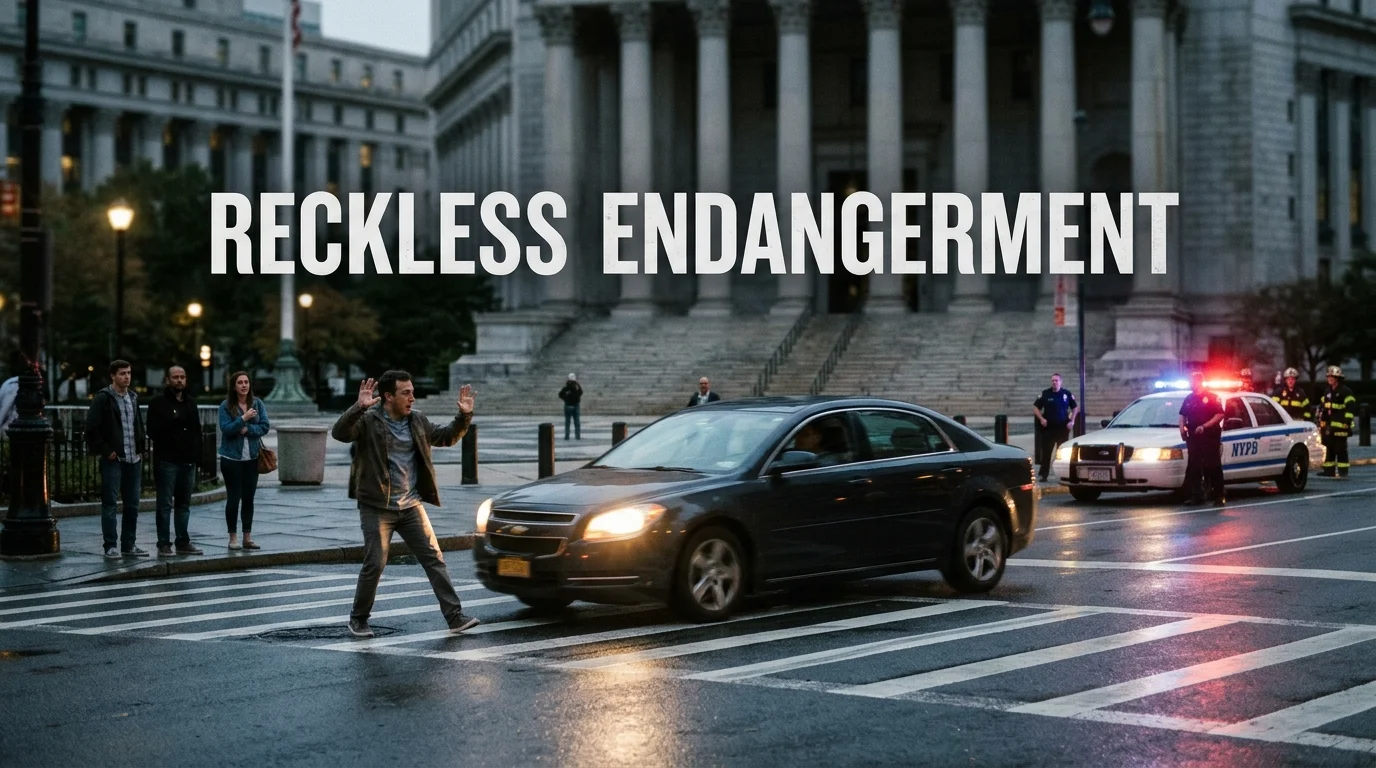
New York court decisions illustrate how vehicle-related allegations can fit this analysis. One 2024 decision involved allegations that a driver drove a vehicle toward another person and stopped shortly before impact, while an earlier case discussed dangerous driving that included crossing lines, traveling the wrong way, and nearly hitting a pedestrian. Those examples show why prosecutors focus on the actual danger created rather than on a label such as “bad driving.”
Misdemeanor vs. Felony: Why the Classification Changes
No nationwide rule states that every endangerment offense is either a misdemeanor or a felony. Some states treat it as a misdemeanor, while others create degrees or aggravating circumstances that allow more serious charges. Weapons, an extreme risk of death, or especially blameworthy conduct can change the potential classification.
| State example | Conduct covered | Classification shown in statute |
|---|---|---|
| New York, second degree | Substantial risk of serious physical injury | Class A misdemeanor |
| New York, first degree | Grave risk of death under circumstances showing depraved indifference | Class D felony |
| Washington | Substantial risk of death or serious physical injury | Gross misdemeanor |
| Pennsylvania | Danger of death or serious bodily injury | Second-degree misdemeanor |
| Tennessee | Imminent danger of death or serious bodily injury | Class A misdemeanor in the basic form |
| Tennessee with a deadly weapon | Same underlying offense with specified aggravating fact | Class E felony |
These examples show why a person should not assume that information about one state applies elsewhere. Tennessee goes further by specifying additional felony levels for certain firearm discharges involving habitations or motor vehicles. New York, by contrast, uses separate degrees and requires a much more serious showing for its first-degree felony statute.
What Penalties Can Follow a Conviction?
Possible consequences depend on the offense grade and the jurisdiction’s sentencing rules. A conviction may expose a defendant to incarceration, probation, fines, court costs, or other conditions the law authorizes. Felony treatment can carry substantially more serious consequences than a misdemeanor classification.
The criminal sentence may not be the only concern. A record can affect employment screening, professional licensing, firearm rights, immigration matters, housing, or other legal proceedings depending on the jurisdiction and the person’s circumstances. Because these collateral effects are fact-specific, anyone facing a charge should get advice from a lawyer licensed in the jurisdiction where the case is pending.
Allegations can also overlap with other legal disputes. For example, claims involving a child’s safety may become relevant in a separate family-law matter, where different legal standards apply. NewsPab’s guide to choosing a child custody lawyer discusses attorney selection and preparation when safety concerns arise in a parenting dispute.
Does Someone Have to Be Injured?
An actual injury is not always necessary because many statutes focus on the risk created by the conduct. New York’s second-degree law refers to creating a substantial risk of serious physical injury, while Washington refers to a substantial risk of death or serious physical injury. Pennsylvania similarly focuses on placing or potentially placing another person in danger.
That distinction is important because endangerment laws can address dangerous behavior before the worst outcome occurs. If serious injury or death does occur, prosecutors may consider additional or more serious charges when the facts and local law support them. The exact relationship between offenses such as assault, homicide, reckless driving, or weapons violations depends on the jurisdiction.
Recklessness, Negligence, and Intent Are Not the Same
People often use “careless,” “negligent,” and “reckless” as if they mean the same thing, but criminal law usually treats them differently. Recklessness commonly involves conscious disregard of a serious risk, while negligence generally concerns a failure to meet an expected standard of care. Intentional conduct involves a different mental state because the person acts with a particular purpose or legally defined intent.
| Mental-state concept | General idea |
|---|---|
| Negligence | Failure to use the required level of care |
| Criminal negligence | A more serious departure from reasonable care, as defined by applicable law |
| Recklessness | Conscious disregard of a substantial or serious risk |
| Intent | Acting with a legally defined purpose or objective |
These distinctions can determine which offense, if any, fits the evidence. A dangerous outcome alone does not necessarily prove that a defendant possessed the mental state required for a particular crime. Prosecutors must connect the evidence to the statutory definition that applies in that jurisdiction.
How Is the Charge Different From Assault?
Assault statutes vary widely, but many require proof of injury, attempted injury, intent, or other elements that are not identical to an endangerment offense. The latter often focuses on creating a prohibited danger even when the feared harm does not occur. That allows prosecutors in some jurisdictions to address high-risk conduct without proving the elements of an assault charge.
The offenses can also appear together when the alleged facts support more than one criminal theory. New York places its endangerment provisions within the same article that contains assault and related offenses, but it defines them separately. Pennsylvania likewise places its statute in the assault chapter while preserving a distinct set of elements.
What Defenses May Be Raised?
A defense depends on the evidence, the wording of the charge, and local law. An attorney may challenge whether the accused acted recklessly, whether the alleged conduct created the required level of danger, or whether the prosecution can prove who committed the act. Other cases may involve justification, unreliable witnesses, disputed video evidence, or procedural issues.
Potential areas of dispute can include:
- The conduct was careless but did not reach the criminal level of recklessness.
- The alleged risk was too remote or minor to satisfy the statute.
- Nobody was actually placed in the legally required zone of danger.
- The prosecution identified the wrong person or misunderstood what occurred.
- Evidence does not reliably establish the required mental state.
- A lawful justification applies under the jurisdiction’s rules.
These are not automatic defenses, and their strength depends on the facts. A person charged with a crime should avoid relying on generalized online examples as a substitute for case-specific advice. A licensed criminal defense lawyer can compare the police reports, witness statements, recordings, and other evidence with the exact statutory elements.
What Should You Do If You Are Charged?
Start by identifying the exact statute and offense level listed on the charging documents. Do not assume the wording used by police, news reports, or social media describes every element prosecutors must prove. Court deadlines, release conditions, evidence-preservation issues, and local procedures can quickly affect a case.
Practical steps may include:
- Keep copies of charging papers, citations, release conditions, and court notices.
- Preserve relevant videos, photographs, messages, receipts, or other records without altering them.
- Avoid contacting alleged victims or witnesses when a court order or release condition prohibits contact.
- Write down important dates and events for your attorney while your memory is fresh.
- Speak with a criminal defense lawyer licensed in the state handling the case.
- Follow every court order and appearance requirement.
Legal proceedings also involve rules about testimony and recorded statements. For readers interested in how sworn testimony works in a different, mainly civil context, NewsPab’s deposition guide explains how testimony may be preserved and used. Criminal procedure differs, so defendants should rely on counsel familiar with the rules governing their case.
Frequently Asked Questions
Is reckless endangerment always a felony?
No, and several state statutes classify the basic offense as a misdemeanor. New York makes its second-degree form a Class A misdemeanor but treats first-degree conduct as a Class D felony, while Washington classifies its offense as a gross misdemeanor. Tennessee also allows felony treatment when specified aggravating circumstances are present.
Can you be charged if nobody was hurt?
Yes, depending on the applicable statute, because the prohibited danger itself may satisfy that part of the offense. New York, Washington, and Pennsylvania each use statutory language centered on risk or danger rather than requiring a completed serious injury. Prosecutors must still prove the remaining elements beyond a reasonable doubt.
Can dangerous driving lead to an endangerment charge?
It can when the driving meets the jurisdiction’s required level of recklessness and creates the necessary risk to another person. Courts look at facts such as speed, direction of travel, proximity to pedestrians or vehicles, evasive behavior, and the severity of the danger. Ordinary traffic mistakes do not automatically establish a criminal mental state.
Does using a firearm automatically make the offense a felony?
Not under every state’s law, so the answer depends on the jurisdiction and facts. Tennessee expressly increases the classification for conduct involving a deadly weapon and provides separate classifications for certain firearm discharges. Other states use different structures, so you must check the specific charging statute.
Is a federal endangerment charge the same as a state charge?
Not necessarily. Federal law uses recklessness concepts in particular settings, including military law and the federal sentencing guidelines, rather than creating one general civilian offense identical to every state statute. State criminal codes remain central in most ordinary state prosecutions.
The Bottom Line
Dangerous conduct can become criminal when it crosses the legal line from ordinary carelessness into the level of risk and recklessness defined by the applicable statute. The line is not identical across the United States, and the difference can determine whether prosecutors charge the conduct as a misdemeanor, a felony, or not at all. Anyone dealing with a real case should read the exact charging statute and seek advice from a qualified lawyer in that jurisdiction.
For continuing coverage of legal terms, rights, and court procedures, visit NewsPab’s Law section. The site’s legal explainers are intended to help readers understand general concepts before they review the rules that apply to their own circumstances.