Last Updated on September 14, 2026 by Nasir Hanif
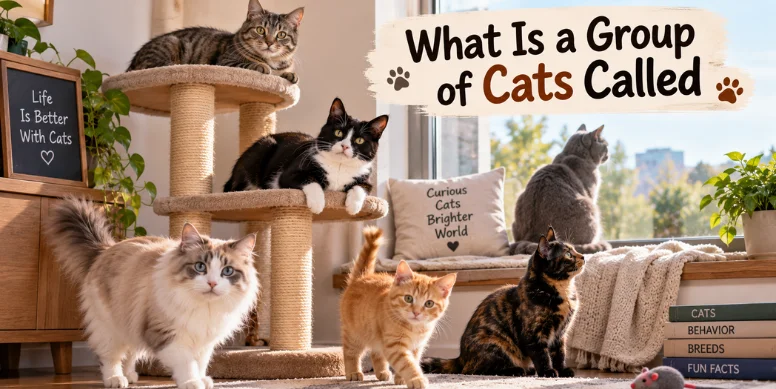
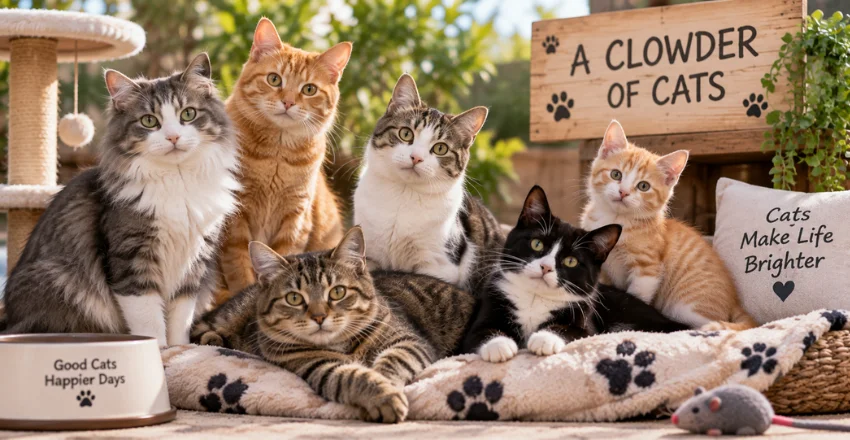
If you’ve ever wondered what is a group of cats called, the standard U.S. English answer is a “clowder.” Merriam-Webster defines clowder simply as a group of cats, making it the clearest dictionary-backed term. Other words apply in certain situations, including colony for community cats and litter for young born together.
A clowder is the standard collective noun for multiple adult cats. In everyday U.S. English, you may also hear “colony” for outdoor community cats, “litter” for kittens born in one birth, and the older or less common term “glaring” for a feline gathering.
| What Is a Group of Cats Called | Term commonly used | What it means |
|---|---|---|
| Adult domestic cats together | Clowder | The standard collective noun for cats |
| Outdoor community or feral cats | Colony | Cats living together in a particular outdoor area |
| Kittens from one birth | Litter | Young born to the same mother at one time |
| Cats gathered together. | Glaring | A colorful, less common alternative term |
| Young cats | Kindle | A traditional term sometimes used for kittens |
TL;DR: Clowder is the safest answer for adult cats. Colony has a practical meaning for outdoor community cats, while litter describes offspring from one birth. “Glaring” and “kindle” appear in collective-noun references, but you’re less likely to hear them in ordinary American conversation.
What Is a Group of Cats Called in American English?
For a general collection of adult domestic cats, “clowder” is the clearest specific word to use. Merriam-Webster’s current dictionary entry defines the noun as a group of cats and says its origin is probably connected to clutter. Dictionary.com also defines a “clowder” as a group or cluster of cats.
You may see websites claim that a clowder must contain at least three animals, but major dictionary definitions don’t set a fixed minimum. Merriam-Webster defines a group broadly as individuals assembled together, and its clowder entry gives no required number. In ordinary conversation, two animals are often called a pair, while a clowder becomes more useful once several are gathered together.
Where Does the Word “Clowder” Come From?
The history of the word helps explain why it sounds unfamiliar today. Merriam-Webster describes it as probably being a variant of clutter, while Dictionary.com connects it with the dialectal word “clodder,” meaning a clotted mass. Dictionary.com records the word from roughly 1795 to 1805, showing that this quirky feline term has been around for more than two centuries.
The pronunciation is simpler than the spelling may suggest. Merriam-Webster gives a pronunciation that sounds like CLOW-der, with the first syllable rhyming with cow or chowder. That makes “a clowder of cats” easier to say than many readers expect when they first encounter the word.
Clowder, Glaring, and Colony: What’s the Difference?
Several terms get repeated online, but they aren’t interchangeable in every setting. “Clowder” works as the general collective noun, while “colony” has a clear real-world use among people who work with outdoor cats. “Glaring” is better treated as a colorful alternative rather than a word you need for ordinary pet care.
| Term | Most useful context | How common is it? |
|---|---|---|
| Clowder | General adult-cat gathering | Dictionary-standard but uncommon in conversation |
| Colony | Community or feral cats living outdoors | Common in animal-welfare contexts |
| Glaring | Playful or traditional collective-noun usage | Rare in everyday speech |
| Group | Any casual gathering | Most natural in normal conversation |
A glaring appears on cat sites and collective-noun lists as another name for cats gathered together. Merriam-Webster’s main entry for glaring, though, defines the familiar adjective connected with staring, brightness, or something painfully obvious. For formal writing or a quiz asking for the standard feline collective noun, clowder is the stronger answer.
A colony has a more practical meaning in modern animal welfare. Alley Cat Allies defines a colony as community cats that are bonded and live together in a particular outdoor area, while its other resources describe community cats as unowned members of Felis catus. Readers interested in broader animal-care topics can also browse the NewsPab Health section.
What Do You Call a Group of Kittens?
For kittens born to one mother at the same time, “litter” is the most precise everyday word. Merriam-Webster defines a litter as the offspring produced at one birth by an animal that can have multiple young. That definition applies neatly to kittens from the same pregnancy.
You may also encounter “kindle” as a traditional collective term for kittens, especially on animal-fact and collective-noun pages. Current cat references such as Cats.com use both litter and kindle when explaining names for young felines. In normal U.S. conversation, though, the letter of kittens will usually sound more familiar and need less explanation.
Do Cats Naturally Live in Groups?
Domestic cats have a reputation for independence, and there is some truth behind it. Cornell University’s veterinary guidance notes that most cats are solitary hunters in natural settings, yet they can live happily with other cats under suitable conditions. Socialization, resources, personality, and the way animals are introduced can all affect whether a multi-cat household stays peaceful.
Living together doesn’t mean cats behave like a wolf pack with a rigid social structure. Cornell also notes that territorial behavior can cause conflict, especially when an unfamiliar animal enters an established space. For related veterinary context, NewsPab also has an article about animal hospital culture.
Outdoor cats can form lasting social arrangements around shelter, territory, and other resources. International Cat Care describes a colony as cats living near one another, often around resources such as food and shelter, while noting that proximity doesn’t always mean every individual has a close social bond. That distinction helps explain why “colony” describes a living arrangement, while “clowder” functions mainly as a collective noun.
Do Big Cats Use the Same Collective Nouns?
Wild members of the cat family have their own familiar group names, so “clowder” isn’t normally the first choice for every feline species. Lions are famously associated with a pride, while collective-noun references include terms such as a coalition for cheetahs, a leap for leopards, and a streak for tigers. These labels help explain why animal collective nouns remain popular in trivia, classrooms, and word games.
| Big cat | Common collective term |
|---|---|
| Lions | Pride |
| Cheetahs | Coalition |
| Leopards | Leap |
| Tigers | Streak |
The distinction also prevents a common vocabulary mix-up. Domestic cats belong to the species Felis catus, while lions, tigers, leopards, and other wild felids belong to different species within the cat family. Merriam-Webster’s definition of “cat” reflects both the domestic species and the wider family that contains these wild relatives.
The Simple Answer to Remember
If a quiz, crossword, or curious child asks for the collective noun for several adult domestic cats, “clowder” is the answer worth remembering. Use colony when discussing community cats living outdoors and litter when talking about kittens from one birth. For more straightforward explainers and general-interest articles, you can continue browsing the NewsPab homepage.
Frequently Asked Questions
What is a group of cats called if they are feral?
Outdoor unowned cats that live together are commonly described as a colony, especially by U.S. community-cat organizations. Alley Cat Allies uses the term for bonded community cats sharing a particular outdoor area. “Clowder” remains grammatically possible as a general collective noun, but “colony” provides more information about the cats’ living arrangement.
Is “glaring of cats” correct?
“Glaring” does appear in animal collective-noun references, so you’ll see the phrase in trivia and pet articles. It is much less useful than a crowd if you want the dictionary-backed general answer. The ordinary dictionary meaning of “glaring” is also far more common in modern American English.
How many cats make a crowd?
There is no fixed number stated in Merriam-Webster’s definition of clowder. Several pet websites describe three or more cats this way, but that number isn’t part of the dictionary definition itself. For two animals, “a pair of cats” will often sound more natural in everyday speech.
How do you pronounce clowder?
“Clowder” is pronounced approximately “CLOW-der.” Its first syllable has the same vowel sound heard in words such as cow and chowder. Merriam-Webster includes the pronunciation in its dictionary entry.
Is a group of kittens called a litter or a kindle?
Both terms appear in cat terminology, but they carry different levels of everyday familiarity. Litter is the clear choice for kittens born together at one birth, and that meaning is supported by standard dictionaries. “Kindle” is an older or less common collective term that you’re more likely to encounter in animal-fact material.