Last Updated on September 23, 2026 by Abdul Rehman
A lessee is the person or business that receives the right to use property or another asset under a lease. The owner or provider is the lessor. The renter usually pays the agreed rent or lease charges, follows the contract terms, and returns the asset or leaves the property when the agreement ends.
The word often appears in apartment agreements, commercial property contracts, vehicle leases, and equipment agreements. Knowing what the role means makes the rest of a lease much easier to read.
| Question | Quick answer |
|---|---|
| Who receives the right to use the asset? | The leaseholder or renting party |
| Who provides the asset? | The lessor |
| Who normally retains ownership? | The lessor |
| What does the renter provide? | Rent or another agreed payment |
| Where is the term used? | Property, vehicles, equipment, and business assets |
| What defines each party’s duties? | The lease agreement and applicable law |
| Does paying under a lease create ownership? | Not by itself |
Key takeaways
- A lease gives temporary use or possession, not automatic ownership.
- The lessor provides the asset, while the other party receives the right to use it.
- A tenant is usually a leaseholder of real property, but the legal term also applies to cars and equipment.
- Payment, maintenance, permitted use, renewal, and termination terms deserve close attention.
- Subletting or transferring an agreement may require consent.
- Local law can add rights or duties that aren’t obvious from the contract.
Lessee vs. lessor: the simplest way to remember the roles
The two words describe opposite sides of the same agreement. The lessor grants the right to use an asset, and the lessee receives that right.
Cornell’s Legal Information Institute describes a lease as a contract in which the lessor grants possession and use for a set period, usually in exchange for rent. Ownership normally remains with the lessor.
| Point | Renting party | Lessor |
| Role | Receives use or possession | Grants use or possession |
| Ownership | Usually does not own the asset | Usually retains ownership |
| Main payment role | Pays rent or lease charges | Receives payment |
| Property example | Apartment tenant | Landlord |
| Vehicle example | Driver leasing the car | Leasing company |
| Contract focus | Use, payment, care, and return | Access, obligations, and enforcement |
A simple memory trick is this: the lessor lets the asset, while the other party receives the lease.
Is the leaseholder the same as a tenant or renter?
The terms overlap, but they aren’t always identical.
A tenant usually occupies real property, such as an apartment, house, office, or store. A leaseholder can also be a company using machinery or a person leasing a vehicle.
The formal leasing term can apply to real estate, equipment, or vehicles. “Tenant” is more closely associated with real property.
“Renter” is the everyday term. It is less precise and may describe someone using property through an arrangement that isn’t a long-term written lease.
This distinction matters when several people use the same property. A person named in the agreement may have financial obligations that an authorized occupant may not have.
Common rights that come with a lease
Exact rights depend on the contract, asset, location, and applicable law. Still, several basic principles appear in many agreements.
The renting party may have the right to:
- use or occupy the asset for the agreed purpose;
- possess it during the stated lease term;
- receive notices required by the agreement or local law;
- expect the other party to perform the duties assigned to them;
- request repairs or maintenance when the agreement places that duty on the owner;
- renew, extend, or purchase the asset if the contract provides that option;
- seek legal remedies when the other party breaches the agreement.
A lease does not normally transfer legal title by itself. Making lease payments alone does not create ownership unless an applicable purchase option is exercised.
Rights can differ sharply among residential property, commercial buildings, vehicles, and equipment. Don’t assume that a rule from an apartment agreement also applies to a business equipment lease.
Common responsibilities of the renting party
Most agreements place clear obligations on the person receiving the asset.
Typical duties include:
- paying rent or lease charges on time;
- using the property only for permitted purposes;
- taking reasonable care of the asset;
- reporting damage or maintenance problems promptly;
- following occupancy, parking, pet, or business-use restrictions;
- carrying insurance when the contract requires it;
- giving proper notice before leaving or terminating the agreement;
- returning the asset in the condition required by the agreement.
Payment, permitted use, maintenance duties, lease duration, renewal, and termination are the contract terms that appear most often.
Responsibility for repairs varies. One contract may assign structural work to the property owner and routine care to the renter. An equipment agreement may allocate maintenance differently.
Reporting promptly matters most after sudden damage, which is why NewsPab’s guide to property damage restoration after a storm stresses early assessment and dated records.
Read the actual clause instead of relying on a general rule.
Seven things to check before signing a lease
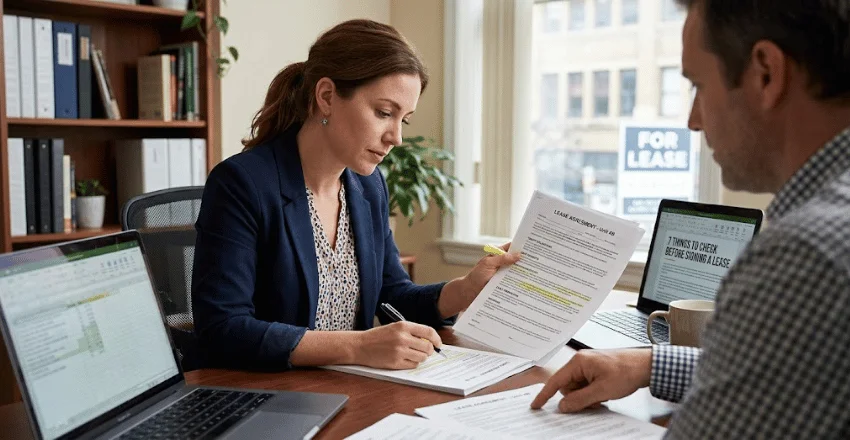
A definition helps, but the contract controls what happens next. These seven checks can prevent expensive surprises.
- Total payment. Confirm the rent, deposits, fees, increases, late charges, taxes, and other costs.
- Length of the agreement. Check the start date, end date, renewal rules, and any automatic extensions.
- Maintenance duties. Identify who handles routine care, major repairs, damage, and replacement.
- Permitted use. Make sure your intended residential, business, vehicle, or equipment use is allowed.
- Early exit terms. Review termination fees, required notice, default rules, and any replacement-renter process.
- Insurance and liability. Check what coverage each party must carry and who bears responsibility for specific losses.
- Return conditions. Note inspection procedures, cleaning rules, wear standards, keys, equipment, and deposit requirements.
Put any important promise in writing. A verbal assurance can be difficult to prove once a dispute begins.
For a high-value commercial agreement or an unclear legal clause, consider having a qualified local lawyer review the document before you sign.
Can a renter sublease or assign the agreement?
A sublease and an assignment are different.
Under a sublease, the original tenant usually remains bound to the main agreement, while another person receives certain occupancy or use rights.
An assignment transfers the remaining interest to another party. Whether the original renter remains financially responsible can depend on the contract, local law, and whether the owner provides a written release. Also worth reading: Tortious Meaning in U.S. Law.
Legal and property guidance also indicates that the original agreement remains important when a sublease is created.
Never assume you can hand the keys to someone else. Check the consent clause first and obtain any required approval in writing.
What happens when the lease ends?
Several outcomes are possible when the stated term expires.
The agreement may:
- end and require the asset to be returned;
- renew for another fixed period;
- continue under a month-to-month arrangement;
- allow a purchase option;
- permit the parties to negotiate a new contract.
The right of use may expire, be renewed, or continue under another arrangement, depending on the contract and applicable law.
Before moving out or returning equipment, review the notice deadlines. Take dated photos, keep receipts, save inspection reports, and request written confirmation of the return.
For residential property, check local rules covering deposits, inspections, and required notices. Those rules can differ by jurisdiction.
Property condition deserves its own paper trail
A rental dispute often begins with a basic question: Who caused the problem, and when did it start?
Document the condition before moving in. Photograph the walls, floors, appliances, windows, ceilings, bathrooms, and any existing damage. Save the files with the date.
If a storm later damages the property, early assessment and proper records determine how the claim is handled.
Moisture deserves the same attention. NewsPab also covers mold prevention and moisture problems in new construction, including inspection and ventilation concerns.
Roof leaks can quickly lead to interior damage. The site’s guide to emergency roof repair and urgent roof problems provides related background on situations that may require a rapid response.
Those resources don’t determine who must pay for a repair. Your agreement and local law determine the answer to that question. They can, however, help you recognize property problems worth documenting and reporting. We cover this in more depth in Disregarded Entity.
A simple apartment example
Imagine Maya signs a 12-month apartment agreement.
She receives the right to occupy the unit, while the landlord retains ownership. Maya agrees to pay monthly rent and follow the property’s stated rules.
The agreement says she must report plumbing leaks promptly. The landlord is responsible for specified building repairs.
Three months later, Maya notices water staining near a window. She emails the property manager, attaches photos, and keeps a copy of the message.
That record helps establish when the problem was reported. It also shows that she followed the notification process described in the agreement.
The lesson applies beyond housing. Good records matter when leasing an office, vehicle, machine, or other valuable asset.
Read the contract by role, not by legal vocabulary
The terminology becomes easier once you know who grants the right of use and who receives it.
After that, focus on the clauses that affect money, maintenance, use, renewal, and exit. Those provisions matter far more than memorizing legal labels.
Before you sign, read the agreement from beginning to end. Mark every clause that creates a payment obligation, deadline, repair duty, or restriction. Ask for unclear points to be explained in writing. More from us: Laches.
Frequently asked questions
In residential and commercial real estate, the terms are often used interchangeably. “Tenant” normally refers to someone occupying real property, while the formal lease term can cover many types of assets.
No. A standard lease grants temporary use or possession. Ownership usually remains with the lessor unless the agreement includes a purchase mechanism that is later exercised.
The answer depends on the agreement and applicable law. Check the maintenance section for provisions covering routine care, structural work, damage, replacement, and emergency procedures.
Sometimes. The contract may allow it, prohibit it, or require written approval. Local law can also affect the answer, so check both before making an arrangement.
Keep the signed agreement, amendments, payment records, notices, inspection reports, photographs, repair requests, and important emails. Store them somewhere you can retrieve them after the agreement ends.